I Didn't Understand AI Skills Until I Built One
A Codex skill is more than a saved prompt. It can package the instructions, resources, and decisions for a repeatable job. I understood that sentence in theory. It took an audio project on my own websites for me to understand what it actually meant.
I had assumed skills were fancy shortcuts. Then I caught myself explaining the same website operation over and over.
It started with one audio player
I began adding short audio enhancements to important pages. Some recordings were Kodi narrating a summary. Others were two-voice conversations produced by Chrome's AI playback. Both started as videos or screen recordings, but they could not use the same presentation.
Kodi's recording needed her credited card, photo, profile link, MP3 player, and a collapsed transcript. A synthetic two-voice conversation needed a plainer player with no borrowed face or personal byline. Each recording still had to be converted, stored where the site expected media, placed in the right part of the page, and checked on a narrow screen.
Then Claude Code added one more useful piece. When a page has playable audio and already appears in the menu, the menu link gets a speaker marker automatically. The marker is data-driven, so it does not have to be placed by hand every time.
None of those steps was especially dramatic by itself. Together, they had become a workflow.
One request, a whole workflow
I didn't write a line of code. I didn't even type one. I pasted $audio-embed into the chat, added the video URL and the page URL, and specified conversation mode for the two-voice recording. That was my part.
$audio-embed <video URL> <page URL> conversation modeCodex handled the conversion, selected the correct presentation, added the transcript and attribution, changed the site, made the speaker icon appear on the page's existing menu link, and checked the result. The command did not create the narration. I supplied the recording. What the skill packaged was everything required to turn that source into a finished website feature.
That distinction matters. The short request did not work by magic. The skill held accumulated workflow knowledge. OpenAI's skills documentation describes a skill as a reusable workflow made from instructions, with optional resources and scripts. This was the first time I felt the full weight of that definition.
The receipt is on the Proof Hub
The clearest example is the Real SEO Life Proof Hub. Before the change, the page had its normal introduction and proof totals. After the change, it had a complete Kodi audio experience placed inside the hero, with a current-context note, player, attribution, and collapsed transcript.
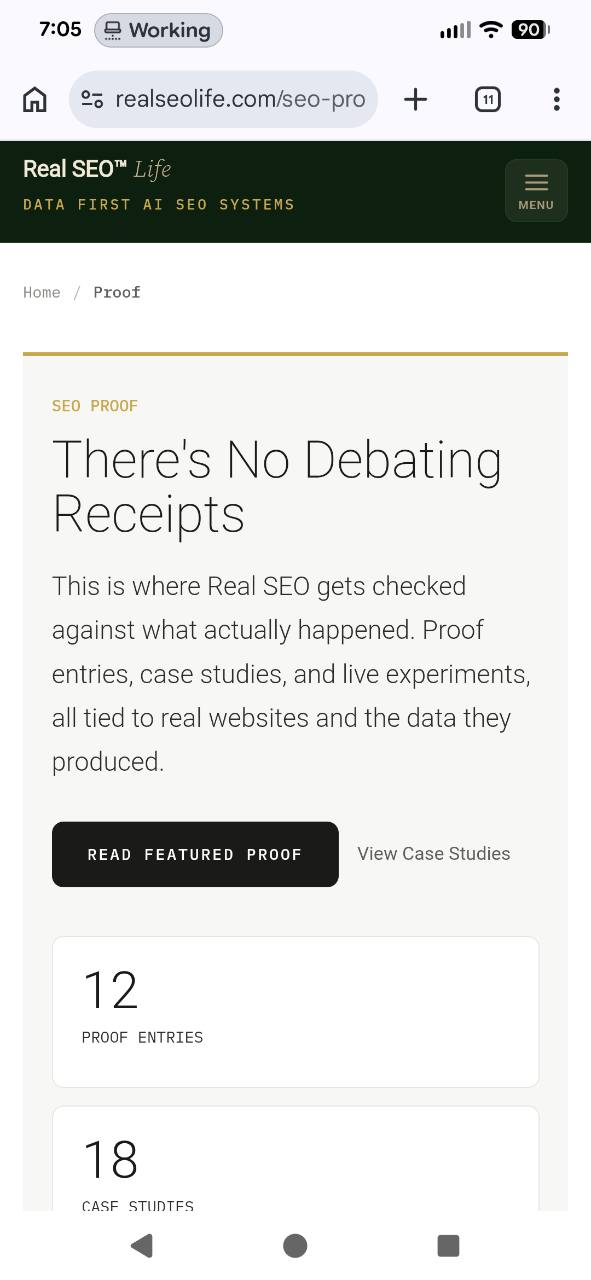

That visible card is the end of a longer sequence: recording, Drive link, download, audio extraction, MP3 placement, component selection, transcript, page integration, a speaker icon on the existing menu link, and live checks.
The skill isn't the foundation
The one-line request is the impressive visible result. The AI Website System underneath it is what makes the workflow practical and repeatable.
Codex and Claude Code are not arriving at an unknown website and improvising from scratch. They can inspect a structured PHP and JSON codebase with predictable content records, reusable components, established media locations, validation tools, and persistent instructions. They know what should be public, what should stay server-side, how a page is resolved, where a transcript belongs, and what must be checked before the work is finished.
The measurement layer matters, too. Publishing the feature is not evidence that it improved search performance or reader behavior. The system keeps the dated change connected to the evidence that can be examined afterward.
A skill becomes substantially more useful when the environment underneath it was designed to be understandable and operable by AI coding agents.
Look for repeated decisions, too
My first instinct was to look for tasks I kept repeating. The better signal turned out to be decisions I kept explaining.
- Use Kodi's credited card when the recording is hers.
- Don't put Kodi's face or byline on a synthetic conversation.
- Put the MP3 where the site expects media.
- Keep the transcript faithful to what was spoken.
- Mark an existing menu link only when its page actually has playable audio.
- Check the live result on a narrow screen before calling it finished.
Those are not just tasks. They are pieces of operating knowledge. Once the decisions are stable enough, they can become part of the skill instead of another explanation I have to give next time.
The skill was not designed perfectly in advance. It developed the same way the website feature did:
Need → solution → repetition → standard → skill
Claude Code solved one piece. Codex solved another. Real use exposed the next requirement. The recurring choices were consolidated only after we had something concrete enough to repeat.
And yes, we did the entire process on my phone from start to finish
I used a Pixel 7 Pro. I pasted the Proof Hub URL into ChatGPT and asked Kodi, my ChatGPT avatar and AI co-architect, to read it back. The Pixel's built-in screen recorder captured the device audio. It can capture a microphone, too, but I did not need a desktop recording setup for this.
When the recording was finished, I shared the video to Google Drive, changed the permission, copied the link, and pasted it into Codex with the destination page URL. I followed the work and reviewed the live result from the same phone.
The actual conversion and website editing ran in the connected Codex environment, so the complexity moved out of my hands without disappearing from the process. My phone was the control surface from beginning to end.
It did not tie up the phone, either. While this job was running, I had other work moving in Claude and Codex at the same time. That may be the most practical part of the whole demonstration. I was not sitting there manually performing each implementation step while everything else waited.
The bigger lesson
If I'm repeatedly explaining to the AI how to do something, I'm probably looking at a skill.
For someone running many websites, that changes how repetitive work should be viewed. I am not merely automating one task. I am gradually capturing operating knowledge and turning it into reusable capability.
$audio-embed is the visible demonstration. The AI Website System is the infrastructure that makes it dependable. Without an understandable architecture, the AI has to rediscover the website every time. With the system, rules, and skills working together, a complicated website operation can eventually become something as simple as one pasted request.
If you want to see how the website, AI operating layer, and measurement record work together, request a System Walkthrough.